Case study · 2026
closin.ai
Closin.ai is the AI-native revenue operations platform for modern RevOps teams. It turns sprawling legacy CRMs into a pipeline the team can understand and act on, with AI agents that take hours of prep off every week and show the deals behind every answer.
The problem
Legacy CRMs are still the industry standard, but they are high-friction platforms in a world that expects faster and more accurate answers than ever.
Where it started
I joined Closin as a founding engineer and designer, when the product was about two months old. The CRM sync and the data model existed. Most of what a sales team would look at every day did not. Over the first stretch I designed and built most of the frontend: forecasting, the reports engine, the deals grid, notifications, the workflow and policy system, and the shared UI package every surface uses. The sections below are the parts that were hard.
What we built
The deals grid at 200,000 rows
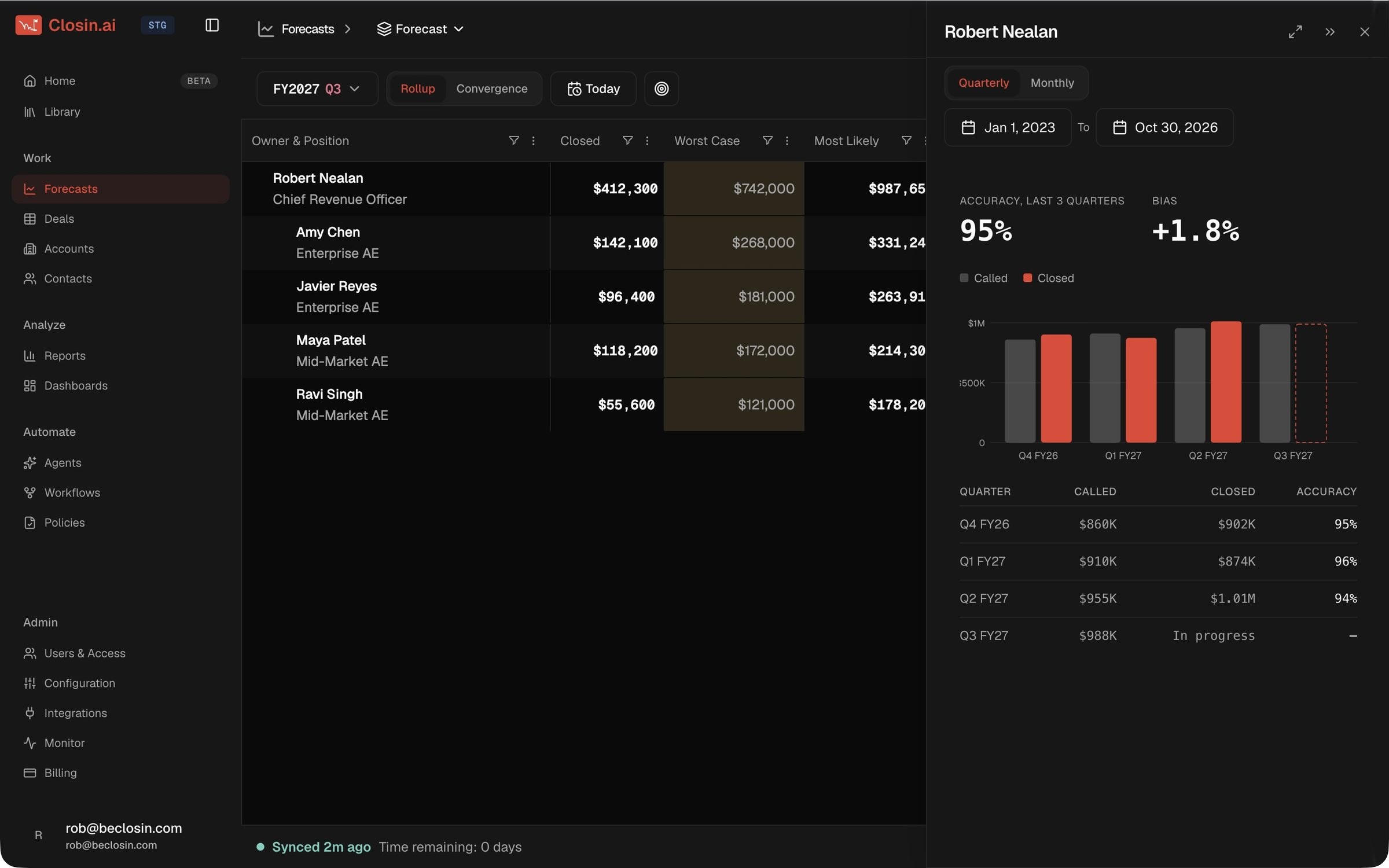
The first grid rendered everything client side and started to struggle past a few thousand deals: 10 to 20 second loads and a scroll that stuttered. Reps live in this view, so it was the first thing I rebuilt. I moved it onto AG Grid's server-side row model, so the browser only ever holds the rows in view and sorting, filtering and grouping run in Postgres through the tRPC API. Edits are optimistic and revert if the write fails, so a rep sees their change land immediately. Underneath, every change to a deal is an event, and the grid can render the pipeline as it stood on any past date from those snapshots. The forecast history, week-over-week views and accuracy drawer are all built on that. Two hundred thousand rows now load in under a second.
Four agents on one workflow engine
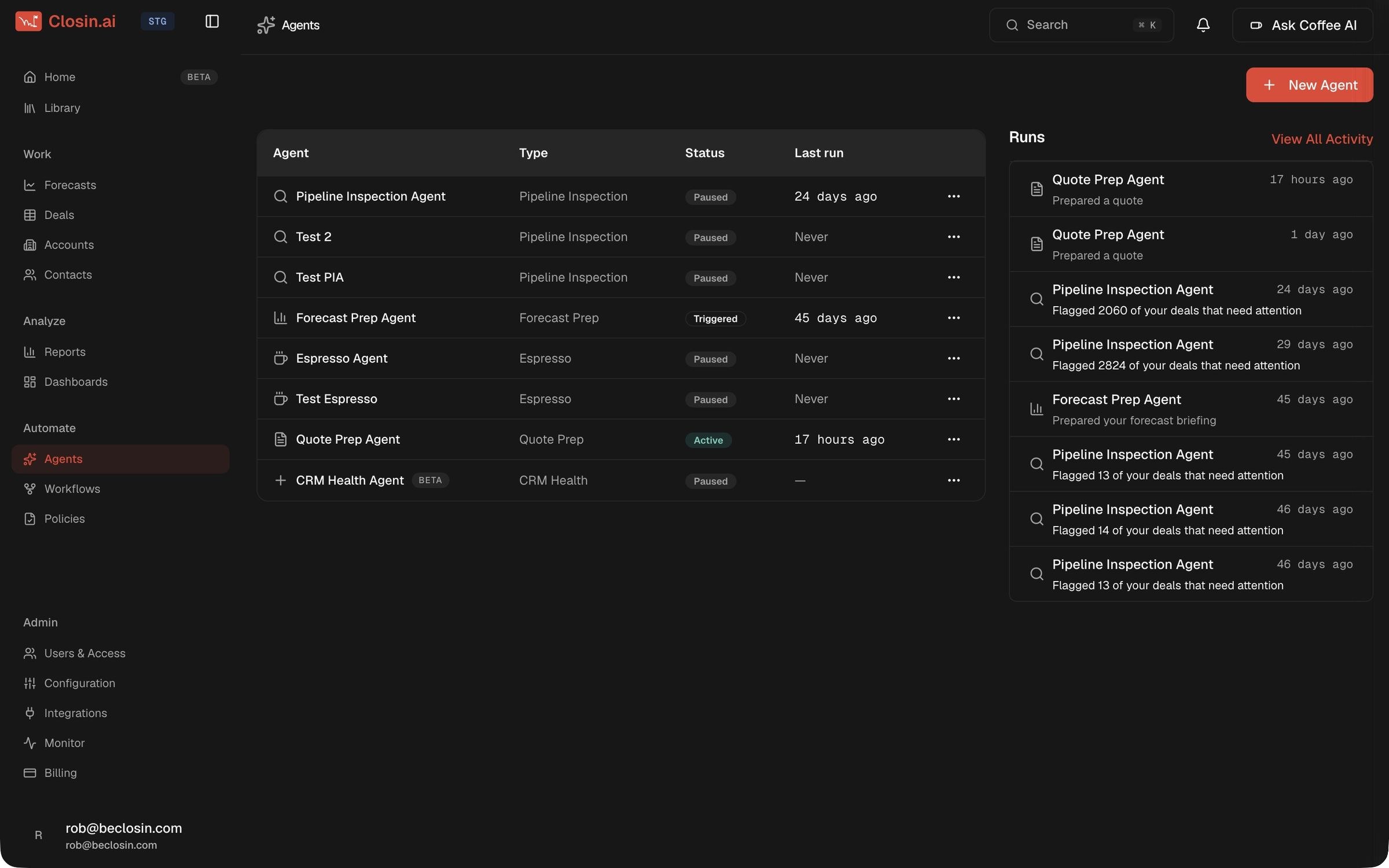
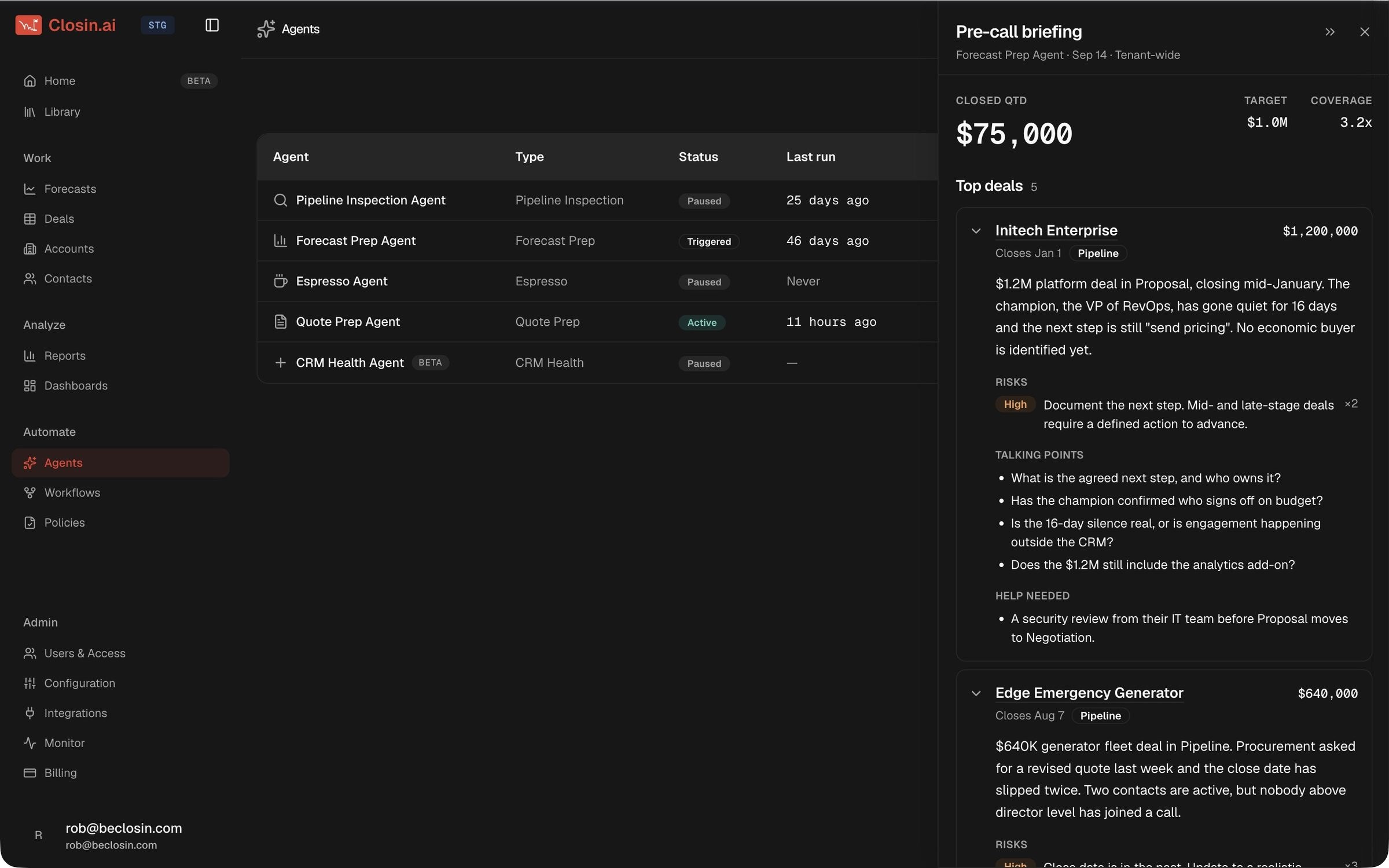
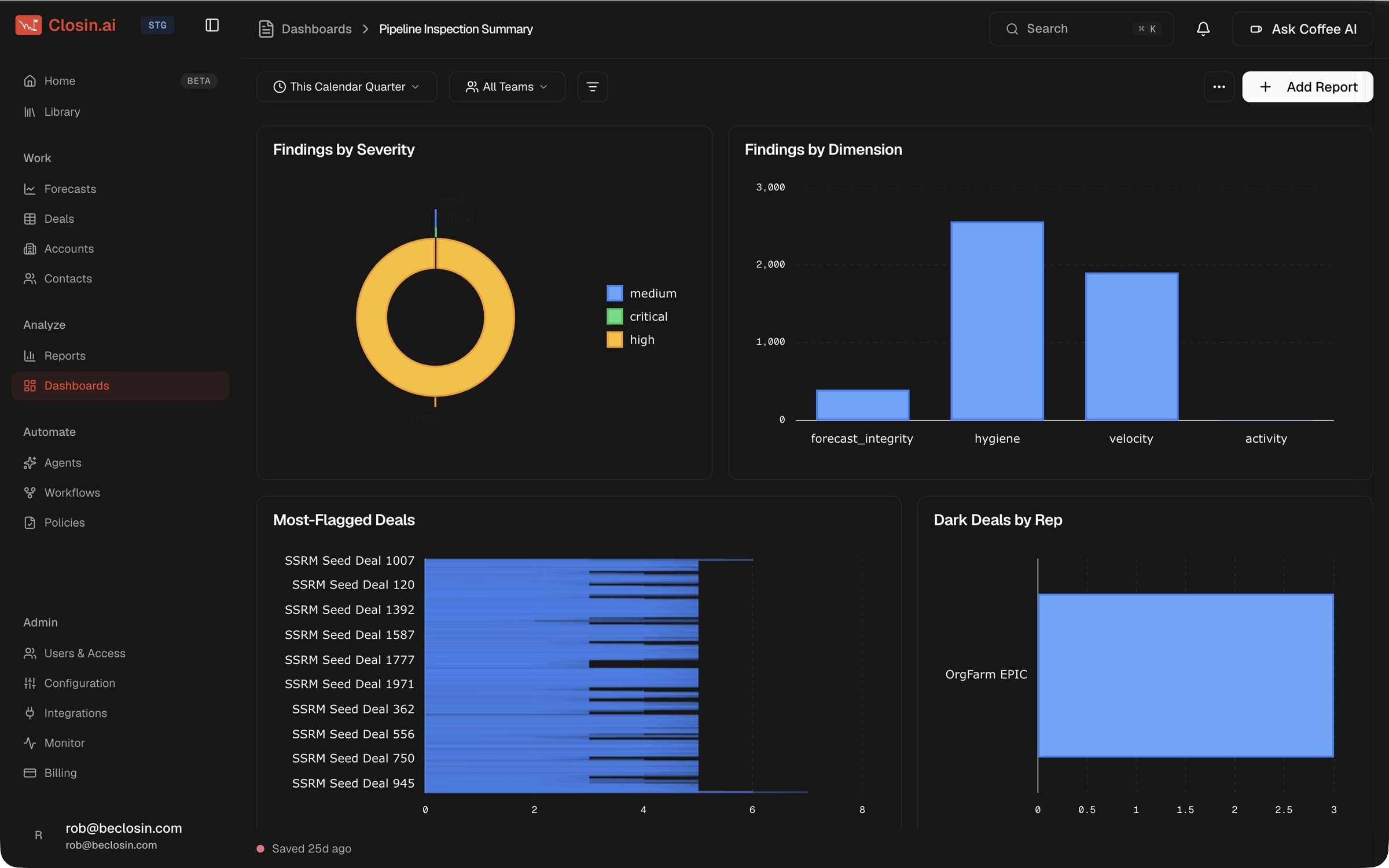
Forecast prep used to be one person's half day every week: pull the pipeline, check what moved, write up talking points. The Forecast Prep agent runs before each team's forecast call and delivers that briefing to Slack or email. Instead of building each agent as its own service, we put them on an editable workflow engine with a cadence, a sequence of tasks, delivery destinations and a run transcript, so a customer can change what an agent does without us shipping code. Pipeline Inspection, CRM Health and Quote Prep run on the same engine. The models are Claude through Amazon Bedrock and the Anthropic API, and Gemini through Vertex AI. CRM Health is the only agent that writes back to the CRM, and it never does so alone: a rep approves, edits or rejects each proposed update. I also piloted a promptfoo eval harness on deal health scoring so prompt changes could be regressed before they shipped.
Deal hygiene
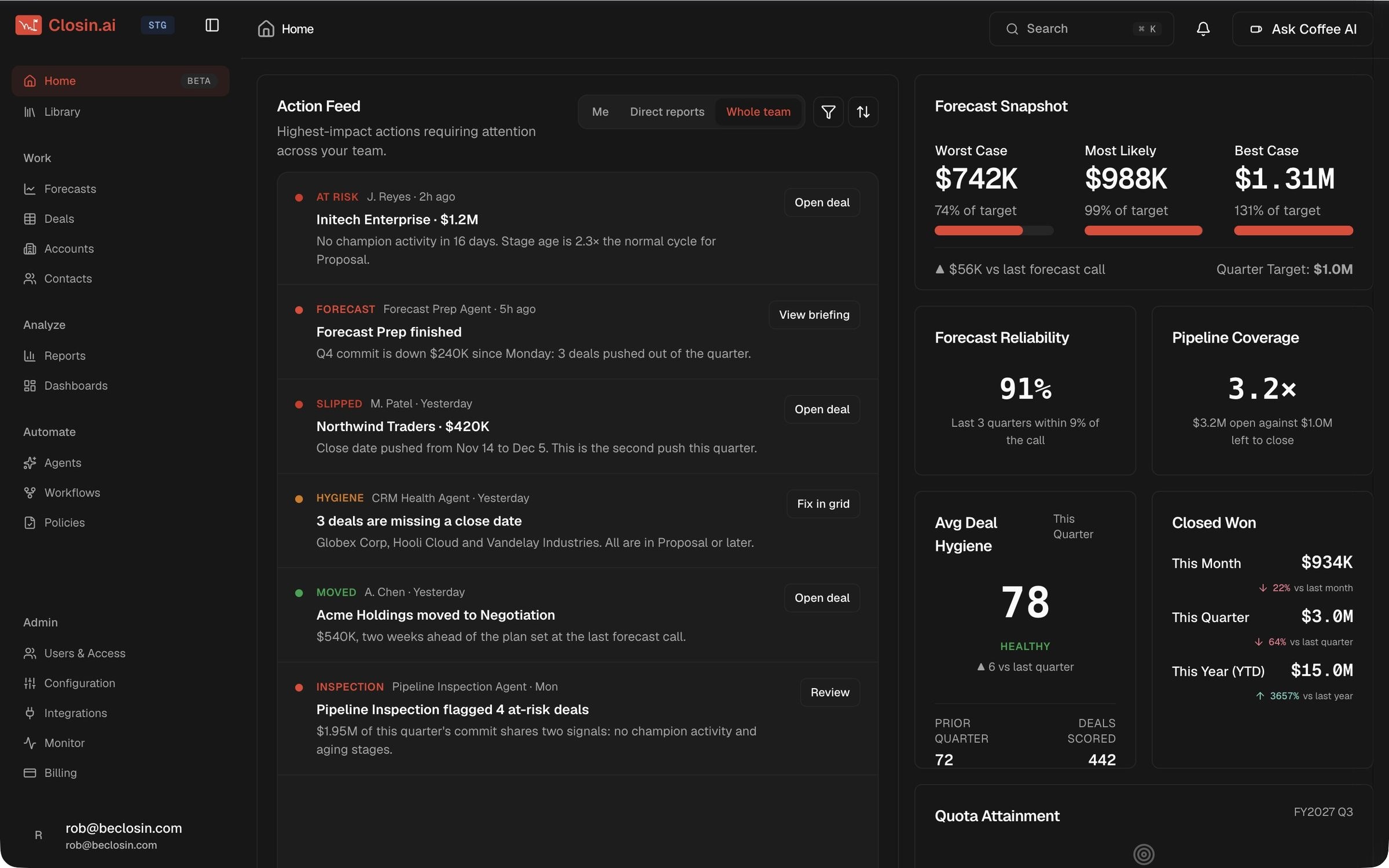
Every open deal gets a hygiene score from rep activity, such as deal updates and email contact, combined with a policy system the customer configures. The score is what the agents and the home feed use to decide which deals need attention first.
Coffee, and answers that show their work
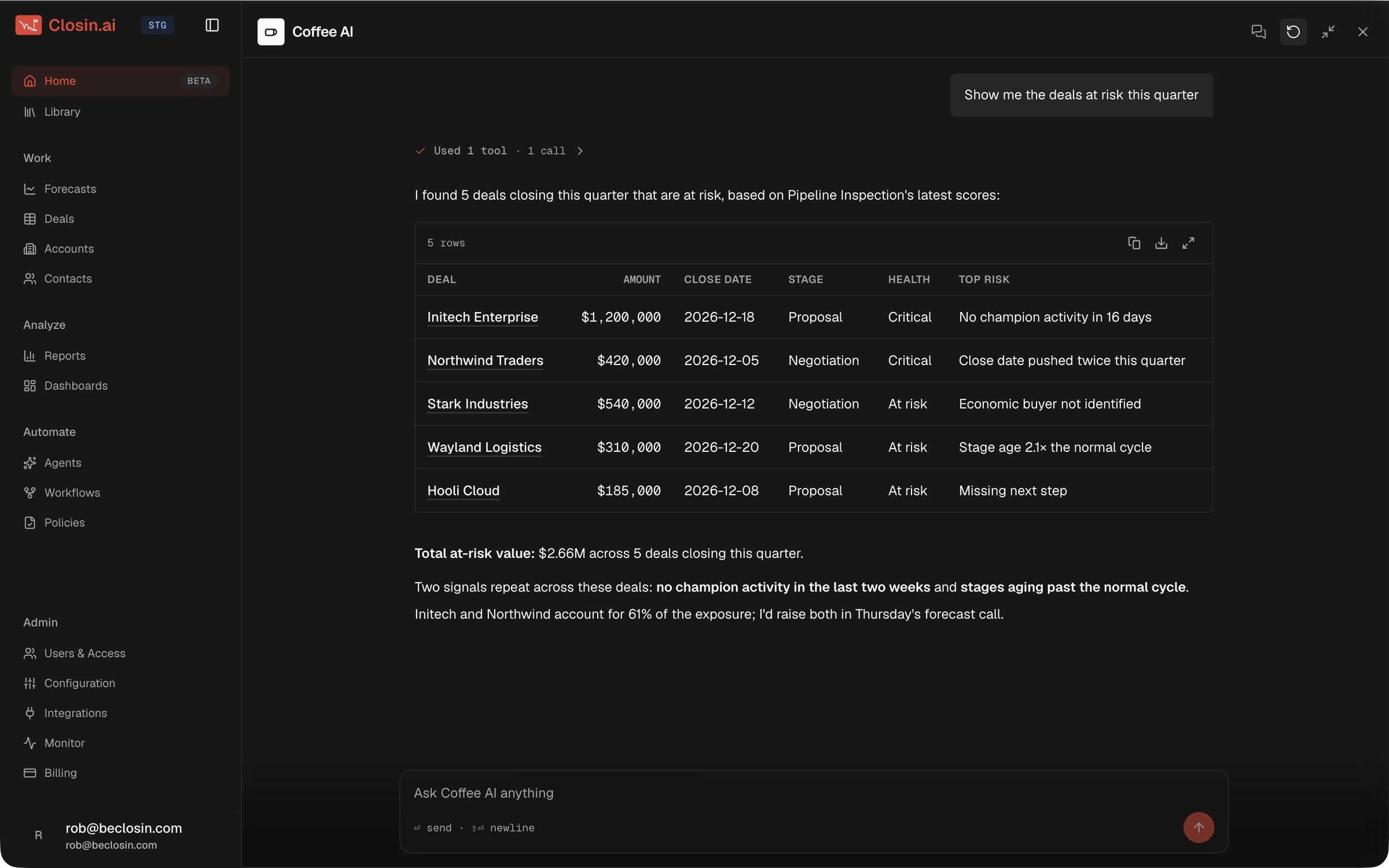
Coffee is the in-app assistant. The redesign made two changes. Every deal or account an answer mentions is a deep link into the app, and when a request is ambiguous Coffee asks a clarifying question instead of guessing. It sees the same data its user does: a rep gets their own deals, a manager their team, a CRO the company, enforced with Postgres row-level security rather than in the prompt. The same data and tools are exposed through Closin's MCP server, so a team can point Claude or Cursor at their pipeline. I extended that server and hardened it against prompt injection.
crema, the UI design system
Closin has four surfaces: the web app, a mobile pilot in Expo and React Native, Coffee, and email. crema is the token-driven component library on Tailwind and Radix that all of them share across the monorepo. Light, dark and system themes resolve before first paint, so there is no flash on load. Once theming worked I tokenized every hardcoded color in the app and added a lint rule that bans raw values, so drift is caught in CI rather than in review. Converging the grays onto one neutral ladder brought every route to WCAG AA contrast. Accessibility lives in the components rather than a fix list: focus returns to the opener when a dialog closes, the report builder supports keyboard-only field assignment, column reorder is announced, and there is a colorblind-safe Okabe-Ito palette mode. The drawers, Coffee included, moved onto one drawer kit with modal variants, single-active coordination and close guards.
Making the system legible to agents
Most of the team's daily work goes through Claude Code, so the design system had to be usable by a model as well as a person. That meant CLAUDE.md guidance on which crema component to reach for, enforcement rules for things like AG Grid usage, custom lint rules, and a /validate command whose RBAC, API and accessibility validators run before a human reviews the PR. CI renders every route as a smoke floor and runs automated code and security review on each day's changes. Design handoffs come out of Claude Design; the marketing homepage was built from one, with an animated hero that respects reduced motion.
The sync pipeline underneath
Salesforce and HubSpot data flows through a multi-tenant AWS pipeline on EventBridge, Lambda and SQS, deployed with CDK. I hardened it with bulk upserts, partial batch failure handling so one bad record does not fail its batch, and a reconciliation sweep for runs stuck in pending. It is the least visible work on this page, and everything above depends on it.